Srila Bhaktivinoda Thakur: Life, Teachings & Legacy
The life and teachings of Srila Bhaktivinoda Thakur — the acharya who rediscovered Lord Chaitanya's birthplace and revived Gaudiya Vaishnavism for the modern age.
Updated 8 October 2026
Srila Bhaktivinoda Thakur: Life, Teachings & Legacy
More than a century ago, Srila Bhaktivinoda Thakur foresaw a day when devotees from Western lands would carry mridangas and karatalas through their own towns, singing the holy names in public kirtan. At the time, it must have sounded like a distant dream. Today, with Hare Krishna temples spanning six continents — including our own community here at Chaitanya Bhavan, Visakhapatnam — that vision has been fully realized.
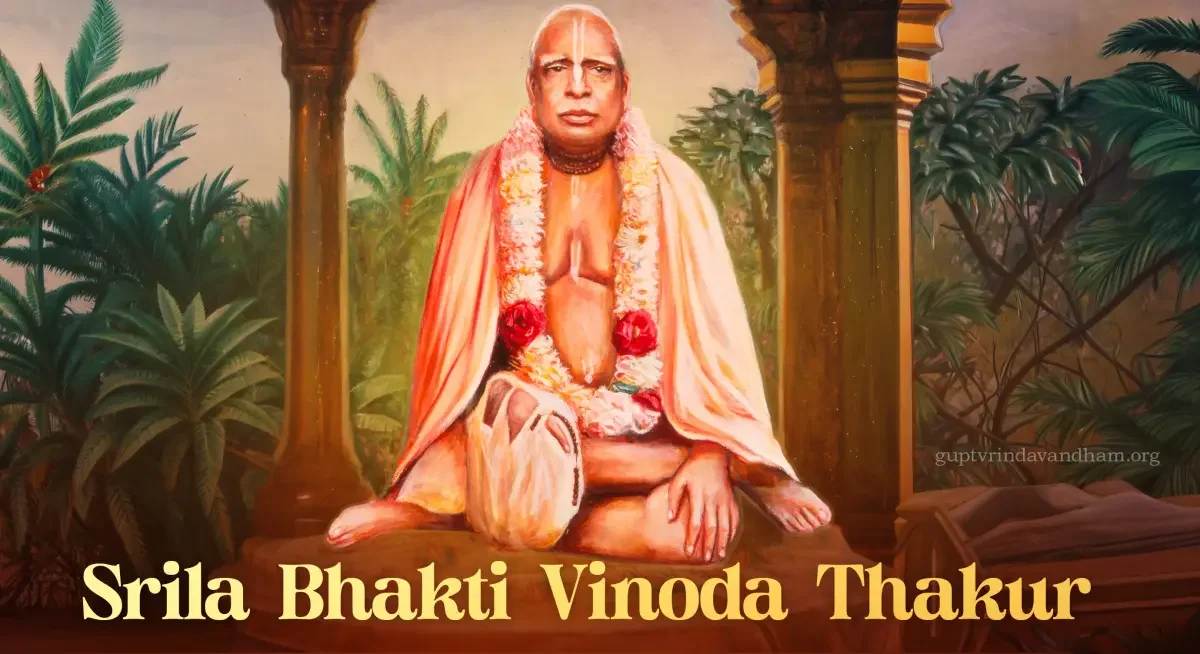
Srila Bhaktivinoda Thakur is remembered as the acharya who revived the teachings of Lord Chaitanya Mahaprabhu after centuries of decline, earning him the title of the Seventh Goswami within the Gaudiya Vaishnava tradition. He was born Kedarnath Datta on September 2, 1838, in the village of Ula (Birnagar) in Bengal's Nadia district, to Ananda Chandra Datta and Jagat Mohini Devi.
A Life at a Glance
| Period | Milestone |
|---|---|
| 1838 | Born into a devout, well-to-do Bengali family |
| Late 1840s | Early education, with growing interest in Vedic scripture |
| 1849 | Lost his father at age 11 |
| Early 1850s | Studied astrology and began questioning the nature of the self |
| 1852 | Relocated to Calcutta to continue his education |
| 1856 | Entered college at age 18 |
| 1860 | First son, Annada Prasada, was born |
| 1861 | Widowed, and later remarried to Bhagavati Devi |
| 1868 | Took up a government post as Deputy Magistrate |
| 1871 | Posted to Jagannath Puri, where he modeled an ideal householder's life |
| 1874 | His fourth son, Bimala Prasada — later Srila Bhaktisiddhanta Sarasvati Thakur — was born |
| 1880–81 | Met Jagannath Das Babaji Maharaj in Vrindavan and accepted him as spiritual master |
| 1888 | Identified the long-lost birthplace of Lord Chaitanya Mahaprabhu |
| 1891 | Launched the Nama-hatta movement across Bengal |
| 1894 | Retired from government service to devote himself fully to preaching |
| 1895 | Installed the deities of Lord Chaitanya and Vishnupriya |
| 1914 | Passed from this world on June 23, entering the eternal service of Radha-Krishna |
Defining Moments in His Life
Uncovering the Lost Birthplace of Lord Chaitanya
Roughly 540 years after Lord Chaitanya Mahaprabhu appeared in Sridham Mayapur, the exact site of His birth had faded from memory, and various claims about its location circulated among devotees. Bhaktivinoda Thakur was determined to settle the question with certainty rather than guesswork.
According to tradition, while seated on the rooftop of a rest house in Navadvipa, he noticed an unusual glow rising from a tall palm tree in the distance. Local residents pointed him toward a nearby mound, overgrown with tulasi, as the spot associated with the Lord's birth. Rather than accept this on hearsay, he turned to the scriptures for confirmation, eventually finding a passage in the Bhakti-ratnakara that matched the description of the site precisely.
To verify the discovery beyond doubt, he invited the elderly Jagannath Das Babaji Maharaj — then said to be over 140 years old and unable to walk unaided — to visit the location. Upon seeing the site, Babaji Maharaj is said to have reacted with overwhelming joy, confirming it at once as the birthplace of "Nimai," Lord Chaitanya's childhood name. That site, now known as Yogapitha in Mayapur, remains a major place of pilgrimage to this day.
A Prayer Answered Through His Own Son
By the late nineteenth century, the sankirtan movement founded by Lord Chaitanya had drifted from its original teachings, with many self-styled "devotees" — referred to as prakrita-sahajiyas — practicing a diluted and distorted version of Vaishnavism. Grieved by this decline, Bhaktivinoda Thakur prayed earnestly to Lord Chaitanya for someone to appear and restore the tradition's original purity.
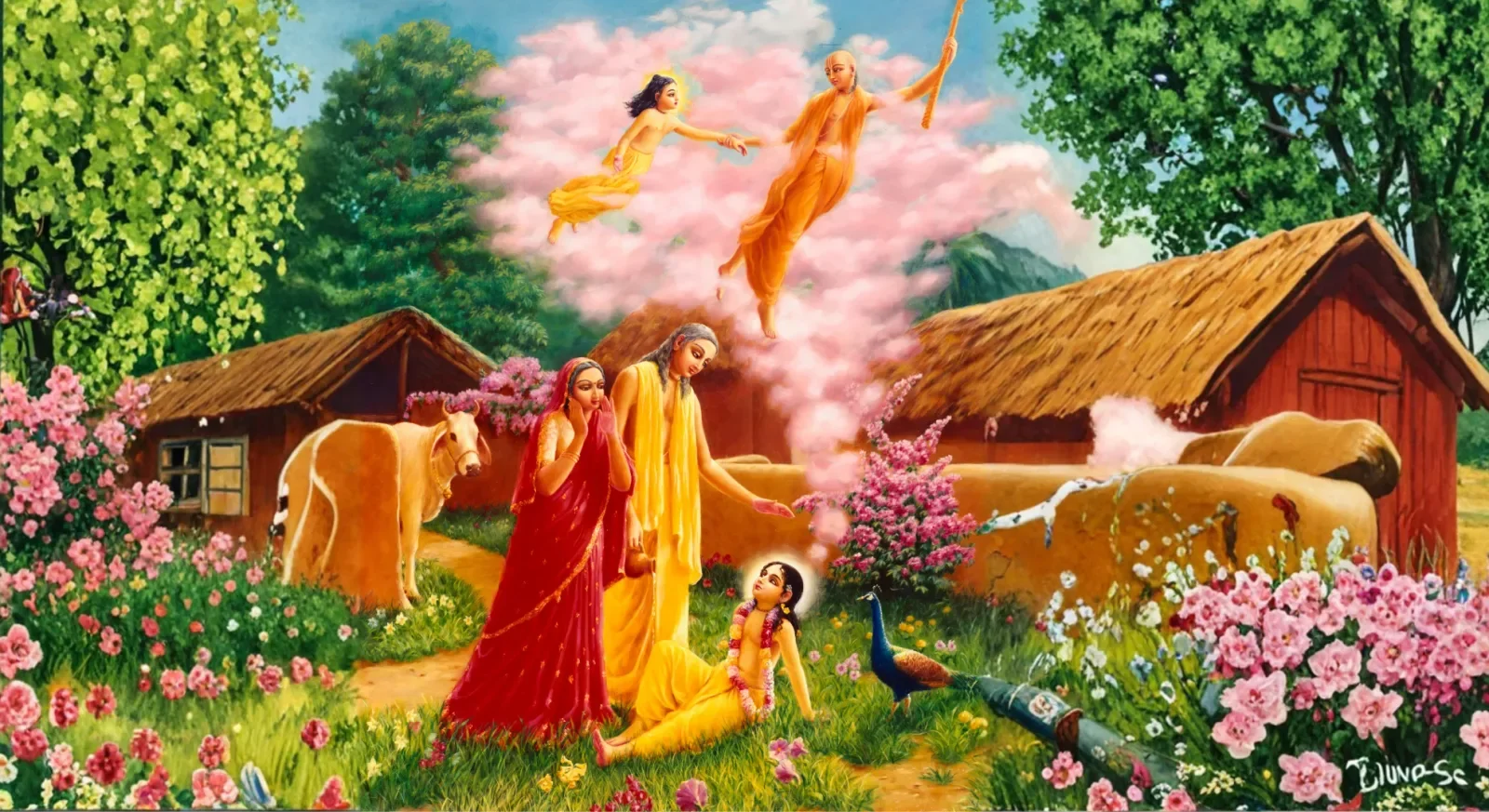
In February 1874, his fourth son, Bimala Prasada, was born — the future Srila Bhaktisiddhanta Sarasvati Thakur. A striking incident is remembered from the boy's infancy: during a Ratha Yatra procession in Jagannath Puri, when the chariot of Lord Jagannath came to a halt directly in front of their home, his mother placed the six-month-old child near the Lord's chariot, and a garland is said to have fallen onto him — a sign Bhaktivinoda Thakur took as confirmation that his prayer had been heard.
Standing Firm Against a False Guru
As Deputy Magistrate of Jagannath Puri, Bhaktivinoda Thakur was also responsible, by local custom, for overseeing matters related to the Jagannath Temple. During his tenure, a self-proclaimed "incarnation of Vishnu" had gathered a following in a nearby village, engaging in behavior unbecoming of any genuine spiritual teacher and openly disparaging the Jagannath Deity as "mere wood."
Recognizing the man as a fraud exploiting people's faith, Bhaktivinoda Thakur went in person, without official pomp, and had him arrested. According to accounts of the episode, the man was believed to hold some mystic influence, and members of Bhaktivinoda Thakur's household reportedly fell ill with fever soon after — yet he remained resolute that the imposter be held accountable, insisting justice mattered more than personal risk. The man was ultimately sentenced and, the story goes, did not survive his imprisonment. The episode is remembered less for its drama and more for what it reveals: Bhaktivinoda Thakur's refusal to let blasphemy against the Lord go unchecked, regardless of personal cost.
A Day in the Life of Bhaktivinoda Thakur
Despite holding a demanding government post, Bhaktivinoda Thakur structured nearly every waking hour around devotional service. A rough outline of his daily routine:
- Late evening (8–10 PM): Rest
- Night (10 PM–4 AM): Writing books and literary work
- Early morning (4–4:30 AM): Brief rest
- Early morning (4:30–7 AM): Chanting japa
- Morning (7–7:30 AM): Correspondence
- Morning (7:30–9:30 AM): Scriptural study
- Late morning (9:30–10 AM): Bathing and a light meal
- Late morning to afternoon (10 AM–1 PM): Court duties, often resolving dozens of cases a day
- Midday (1–2 PM): Return home
- Afternoon (2–5 PM): Continued court duties
- Evening (5–7 PM): Translating Sanskrit texts into Bengali
- Evening (7–8 PM): Bathing and evening meal
This disciplined balance of professional duty and devotional practice is precisely why he's remembered as a model for householders — proof that a full-time career and a serious spiritual life aren't mutually exclusive.
How Srila Prabhupada Spoke of Him
Srila Prabhupada frequently credited Bhaktivinoda Thakur with reviving Krishna consciousness at a time when its original teachings had been all but lost, referring to him as a nitya-siddha — an eternally liberated soul who appeared specifically to guide people of this age. Bhaktivinoda Thakur himself had predicted that a future personality would carry Lord Chaitanya's message across the entire world — a prophecy Srila Prabhupada fulfilled by circling the globe more than a dozen times, though he attributed the achievement entirely to his predecessors rather than himself.
Srila Prabhupada also often pointed to Bhaktivinoda Thakur as the ideal example of a householder devotee — someone who fulfilled his family and professional responsibilities fully while never once neglecting his devotional life, and who raised a son, Bhaktisiddhanta Sarasvati Thakur, who would go on to become one of the towering gurus of Gaudiya Vaishnavism.
His Eternal Spiritual Identity
In the fifth chapter of his work Gitamala, Bhaktivinoda Thakur described his own eternal spiritual identity as Kamala Manjari — depicted as an ever-youthful maiden residing in Svananda-sukhada-kunja, who serves alongside Lalita Sakhi in preparing camphor and other offerings in the eternal service of Srimati Radharani.
Lasting Contributions to Gaudiya Vaishnavism
A vast body of literary work. Over the course of his life, Bhaktivinoda Thakur authored close to a hundred books across Bengali, Odia, and English, covering philosophy, scriptural commentary, and practical devotional guidance. Works such as Jaiva Dharma, Saranagati, and Sri Harinama Chintamani remain foundational reading in the tradition today.
Rediscovering Mayapur and reviving Nama-hatta. Beyond identifying Lord Chaitanya's birthplace, he established the Nama-hatta system — informal, community-based gatherings for congregational chanting and discussion of Krishna consciousness — extending the movement's reach well beyond temple walls.
A treasury of devotional songs. Bhaktivinoda Thakur composed hundreds of devotional songs and prayers, many of which remain central to temple worship today, including Gaura Aarti, Jaya Radha Madhava, and Ohe Vaishnava Thakur. Srila Prabhupada often remarked that simply singing these compositions — even without fully grasping their meaning — has the power to soften even the hardest of hearts.
Places Associated With His Life
- Birnagar (Ula), Nadia — his birthplace and site of early education
- Calcutta — where he pursued higher studies and later lived as a householder
- Jagannath Puri, Odisha — where he served as Deputy Magistrate, managed temple affairs, and where his son Bhaktisiddhanta Sarasvati was born
- Vrindavan — where he accepted Jagannath Das Babaji Maharaj as his spiritual master
- Mayapur (Yogapitha) — site of his rediscovery of Lord Chaitanya's birthplace
- Godrumadvipa, Surabhi Kunja — where he built a bhajan kutir and organized Nama-hatta gatherings
- Svananda Sukhada Kunja, Godrumadvipa — his residence in retirement, where much of his later literary work was completed
Frequently Asked Questions
Who was Srila Bhaktivinoda Thakur? An acharya in the Gaudiya Vaishnava tradition who revived the teachings of Lord Chaitanya Mahaprabhu after they had faded following the disappearance of the original six Goswamis.
Where was he born? In Ula (Birnagar), in the Nadia district of West Bengal, in 1838.
What was his eternal spiritual identity? He identified himself, in his own writings, as Kamala Manjari, a maidservant of Srimati Radharani in the spiritual world.
What was his wife's name? He was married to Bhagavati Devi following the passing of his first wife.
What was his birth name? Kedarnath Datta.
Who composed the Gaura Aarti? Srila Bhaktivinoda Thakur, among his many devotional compositions.
Who were his notable children? His fourth son, Bimala Prasada, became the renowned acharya Srila Bhaktisiddhanta Sarasvati Thakur.
In Closing
From uncovering a lost birthplace to composing hundreds of devotional songs, Srila Bhaktivinoda Thakur's life stands as proof that devotion to Krishna doesn't require withdrawing from worldly responsibility — it requires bringing every part of one's life into that service. His example continues to guide devotees, including our own community at HKM Visakhapatnam, in balancing everyday duties with a serious, sustained spiritual practice.
Want to learn more about the acharyas in our spiritual lineage? Visit us at Chaitanya Bhavan, Visakhapatnam, or explore our other blog posts on Krishna consciousness and Gaudiya Vaishnava history.