Ratha Yatra: History, Significance & Celebrations
Discover the story behind Ratha Yatra, the ancient Festival of Chariots — from its origins in Jagannath Puri to how it's celebrated at Hare Krishna temples today.
Updated 8 October 2026
Ratha Yatra: History, Significance & Celebrations
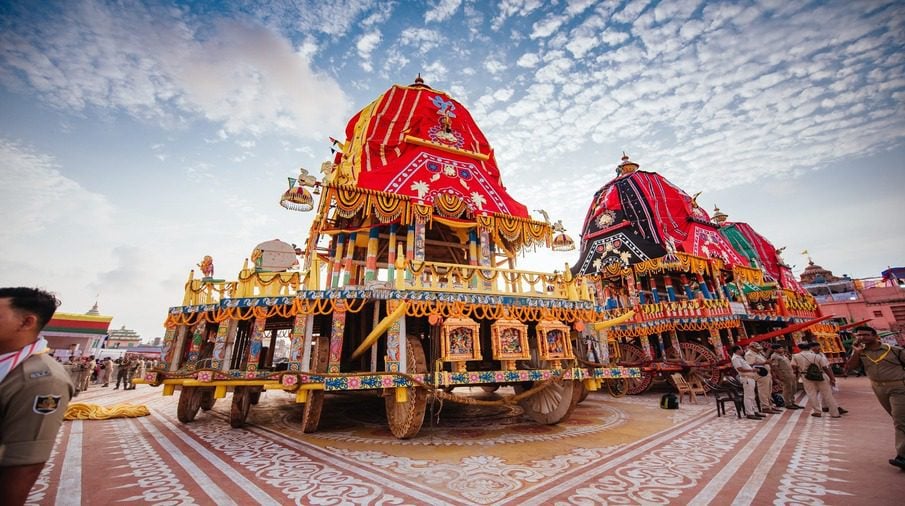
Once a year, streets that are ordinarily filled with traffic and daily routine transform into a river of color, music, and devotion, as massive wooden chariots carrying Lord Jagannath, Baladeva, and Subhadra Devi roll forward, pulled not by machines but by the hands of thousands of devotees. This is Ratha Yatra — the Festival of Chariots — one of the oldest continuously celebrated festivals in the world, and one of the most joyous occasions on the Hare Krishna Movement's calendar.
Origins in Jagannath Puri
Ratha Yatra traces its roots back thousands of years to the coastal temple town of Jagannath Puri in Odisha, home to the ancient deity of Lord Jagannath — a form of Krishna Himself. According to tradition, this unique form, with its wide eyes and distinct features, expresses Krishna's mood of intense separation and longing for the residents of Vrindavan after He departed for Mathura, leaving behind the cowherd community that had known Him as a child.
Each year, the deities of Jagannath, His brother Baladeva, and sister Subhadra are ceremonially brought out of the main temple and placed on towering, ornately decorated chariots, then pulled in procession to the Gundicha Temple, where they reside for several days before returning home.
Lord Chaitanya's Role in Popularizing the Festival
While Ratha Yatra had already been observed in Puri for centuries, it was Lord Chaitanya Mahaprabhu, some five hundred years ago, who transformed it into an occasion of overwhelming devotional celebration. Accounts from His biography, the Chaitanya Charitamrita, describe Him leading kirtan and dancing before the chariots with such intensity that onlookers were moved to tears. He is also remembered for personally cleaning the Gundicha Temple before the deities' arrival — an act of humility that devotees still commemorate today through the ritual of Gundicha-marjana, or temple cleansing, ahead of the festival.
How Srila Prabhupada Brought Ratha Yatra to the World
Srila Prabhupada held a lifelong affection for Ratha Yatra, reportedly building his own small cart as a five-year-old child in Kolkata and pulling it through his neighborhood with friends long before he would go on to found ISKCON. Decades later, he introduced the festival to cities across the West, beginning in San Francisco in 1967 — the first time Lord Jagannath's chariot procession had ever taken place outside India.
Since then, Ratha Yatra has become one of the most visible public celebrations of the Hare Krishna Movement, with processions now held annually in major cities across nearly every continent — from Toronto and Montreal to London, Sydney, and beyond — each one open to the public regardless of background or belief.
What Happens During the Festival
A typical Ratha Yatra celebration includes:
- The procession itself — devotees, often numbering in the thousands, take turns pulling the ropes attached to the chariots, considered a highly meritorious act of devotional service.
- Continuous kirtan — chanting and dancing accompany the chariots throughout the route, with musicians playing mridangas and karatalas.
- Prasadam distribution — sanctified vegetarian food is offered freely to everyone along the route and at the festival grounds.
- Cultural programs — many celebrations include stage performances, philosophy talks, and community stalls once the chariots reach their destination.
Why Devotees Consider It So Significant
Traditional teachings hold that simply witnessing the Lord on His chariot carries deep spiritual benefit — considered by devotees to be a step toward liberation from the repeated cycle of birth and death. This belief is part of why Ratha Yatra is treated not merely as a cultural spectacle, but as a genuine opportunity for spiritual advancement, available to anyone who joins, participates, or even just watches the chariots pass by.
Frequently Asked Questions
What is Ratha Yatra? Ratha Yatra, or the Festival of Chariots, is an annual procession in which the deities of Lord Jagannath, Baladeva, and Subhadra are carried through the streets on large decorated chariots.
Where did Ratha Yatra originate? The festival originated in Jagannath Puri, Odisha, where it has been observed for thousands of years.
Who introduced Ratha Yatra outside India? Srila Prabhupada, founder of ISKCON, introduced the festival to the West, holding the first celebration outside India in San Francisco in 1967.
What is the significance of Lord Jagannath's form? Jagannath is understood to be a form of Krishna expressing intense separation and longing for His childhood companions in Vrindavan.
Can anyone participate in Ratha Yatra? Yes — Ratha Yatra celebrations are open to the public, regardless of background, and typically include free prasadam and cultural programs for all attendees.
In Closing
Ratha Yatra captures something rare: a festival that is at once deeply ancient and remarkably contemporary, rooted in centuries-old tradition yet still drawing crowds of newcomers in cities worldwide. Whether pulling the chariot rope, joining the kirtan, or simply watching from the roadside, every participant in Ratha Yatra takes part in a celebration that Srila Prabhupada dedicated his life to sharing with the world.
To learn about upcoming festivals and celebrations at HKM Visakhapatnam, stay connected with us at Chaitanya Bhavan, Gambhiram.