After the Swings Are Put Away: Carrying Jhulan Yatra Into Everyday Seva
Jhulan Yatra shows Radha and Krishna in Their most intimate mood. Here is what the swing festival teaches about service, and how to keep its spirit all year.
Updated 8 October 2026
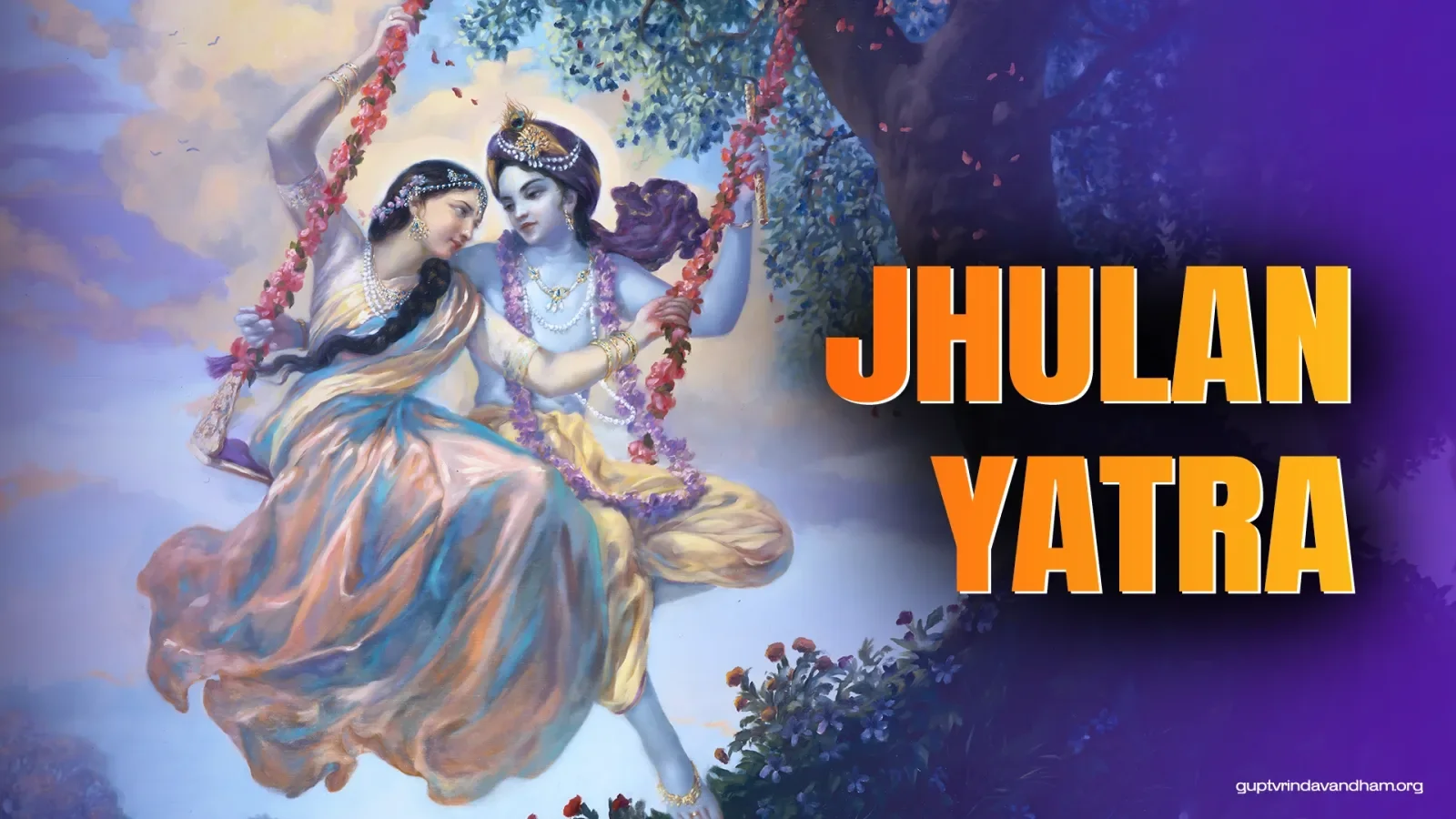
For a few evenings in the monsoon month of Shravana, temples across the world bring out a beautifully decorated swing, place the Deities of Sri Sri Radha and Krishna upon it, and invite devotees to pull the flower-laden rope while kirtan fills the hall. This is Jhulan Yatra, the swing festival, which runs from the Ekadashi of the bright fortnight of Shravana up to the full moon of Balarama Purnima. At ISKCON Visakhapatnam, as in every Hare Krishna temple, it is one of the sweetest and most intimate celebrations of the year.
The swings have now been put away and the decorations taken down for another year. But a festival is not meant to be a memory that fades with the decorations. Each celebration in the Vaishnava calendar carries a lesson that is meant to stay with us. So what does Jhulan Yatra teach, and how can a devotee keep its mood alive through the rest of the year?
A Pastime of Intimacy, Not Grandeur
Most of the festivals we observe celebrate the Lord's power: Lord Nrisimha tearing apart Hiranyakashipu, Lord Rama crossing the ocean, Krishna lifting Govardhana Hill. Jhulan Yatra is different. It celebrates the Lord in His most relaxed and affectionate mood, enjoying the cool breeze and rain-washed groves of Vrindavan with Srimati Radharani and the gopis, who push the swing and sing for His pleasure.
Srila Prabhupada explained that Krishna has two broad features: His opulence (aishvarya) and His sweetness (madhurya). In Vaikuntha the Lord is worshipped with awe and reverence. In Vrindavan the residents forget that He is God at all; they simply love Him as their friend, their child or their beloved. Jhulan Yatra belongs entirely to this second world. Nobody pushing the swing is thinking of the Lord as the creator of universes. They are thinking only of how to make Him smile.
Why the Lord accepts such small services
One might ask why the Supreme Person, who is complete in Himself, should care whether someone gently pulls a rope. Lord Krishna answers this in the Bhagavad-gita (Bg. 9.26): if one offers Him a leaf, a flower, a fruit or water with devotion, He accepts it. The Lord does not need our offerings. What attracts Him is the love behind them. A child who brings her mother a crushed flower picked from the roadside gives her more pleasure than a stranger who brings an expensive bouquet. Jhulan Yatra trains us to see service in this way.
What We Learn Standing at the Rope
Anyone who has pulled the swing in the temple knows how simple the act is, and yet how absorbing it becomes. You are told to pull gently, not to jerk the rope, to watch the Deities' ornaments and garlands, to wait your turn so others can serve too. In those few minutes there are several lessons hidden.
1. Service is about the pleasure of the one served
If you pull too hard, the swing jolts. If you pull too softly, it barely moves. The devotee has to keep adjusting according to what pleases the Deity, not according to what feels exciting to himself. This is a small picture of the whole of bhakti. Rupa Goswami describes pure devotional service as activity meant favourably for Krishna, free from personal motives (Bhakti-rasamrita-sindhu 1.1.11, discussed in Prabhupada's Nectar of Devotion). The swing is a lesson in "favourable" service.
2. Everyone gets a turn
Temples usually let devotees and guests take turns at the rope. A first-time visitor stands next to someone who has served for thirty years. On the swing festival there is no hierarchy at the rope; everyone simply wants to serve. This reflects the spirit of Sri Chaitanya Mahaprabhu's movement, where the Holy Name and the opportunity for service are given freely to all.
3. Kirtan makes the service complete
Jhulan Yatra is never silent. The pulling of the swing is always accompanied by singing. In the Srimad-Bhagavatam (SB 7.5.23–24), Prahlada Maharaja lists nine processes of devotional service, beginning with hearing and chanting. Jhulan beautifully combines several of them at once: hearing the kirtan, chanting along, remembering Radha and Krishna in Vrindavan, serving the Deities, and offering everything to Them.
Carrying the Mood of Jhulan Through the Year
The swing comes out only once a year, but the attitude it teaches can be practised every day. Here are a few simple ways to keep the festival alive at home and in the community.
Turn your home altar into a place of daily service
If you have pictures or small Deities of Radha and Krishna at home, try to give Them a small daily service that you do with care rather than routine: changing the flowers, offering a lamp in the evening, or cleaning the altar. Do it the way you pulled the rope, gently and attentively, thinking of Their pleasure.
Offer your food before you eat it
Cook vegetarian food without onion and garlic, place it before the Lord with a simple prayer, and then honour it as prasadam. This single practice transforms the kitchen into a temple and the family meal into a festival. Lord Krishna's promise in Bg. 9.26 applies just as much on an ordinary Tuesday as it does on the swing festival.
Keep kirtan in your life
Even ten minutes of singing the Hare Krishna maha-mantra with family in the evening recreates something of the Jhulan atmosphere. Chanting together binds a home in a way nothing else can.
Serve wherever you are asked
On Jhulan nights, devotees cut flowers, string garlands, wash utensils, manage the queue and distribute prasadam. Nobody remembers who did which job; they remember the joy of serving together. That joy is available every week at the temple, whether through cooking, cleaning, helping during festivals or supporting the food distribution programme.
The Inner Swing
External festivals are meant to awaken an internal mood. In that sense, the real Jhulan Yatra is when our mind swings back and forth not between material anxieties, but between remembering Krishna and serving Krishna. In Bg. 9.34 the Lord asks us to always think of Him, become His devotee, worship Him and offer homage to Him. The swing festival gives us a taste of what that looks like when it is happening all at once.
A festival ends on the calendar, but the mood it awakens is meant to remain in the heart.
As the rainy season gives way to autumn and we enter the months of Kartik and Damodar, the devotional calendar continues to offer one opportunity after another. If Jhulan Yatra moved you this year, let it become a doorway into regular practice: daily chanting, a home altar, offering your food and, whenever possible, coming to the temple to serve.
Stay Connected With Hare Krishna Vizag
The Hare Krishna Vaikuntham Cultural Centre at Gambheeram welcomes everyone to take part in the life of the temple, not only on festival days. You can see the regular programmes on our daily schedule, look ahead to upcoming celebrations on the Vaishnava calendar, or offer your time through our volunteer team. If you would like to support the worship of Sri Sri Radha Madan Mohan and the festivals of the year, you can do so through our donation page.
May the gentle mood of the swing festival stay with you, and may Radha and Krishna accept every small service you offer.