Gopashtami: The Day Krishna Became a Cowherd
Gopashtami remembers the day Krishna and Balarama first took charge of the cows of Vrindavan. Its meaning, its link to cow protection, and how to observe it.
Updated 8 October 2026
Among the many names of Lord Krishna, few are as beloved in India as Gopala, the protector of the cows, and Govinda, the one who gives pleasure to the cows, the land and the senses. These names are not poetic decorations. They describe what Krishna actually did in Vrindavan, day after day, as a young cowherd boy. And there is one day in the month of Kartik set aside especially to remember the beginning of that service: Gopashtami.
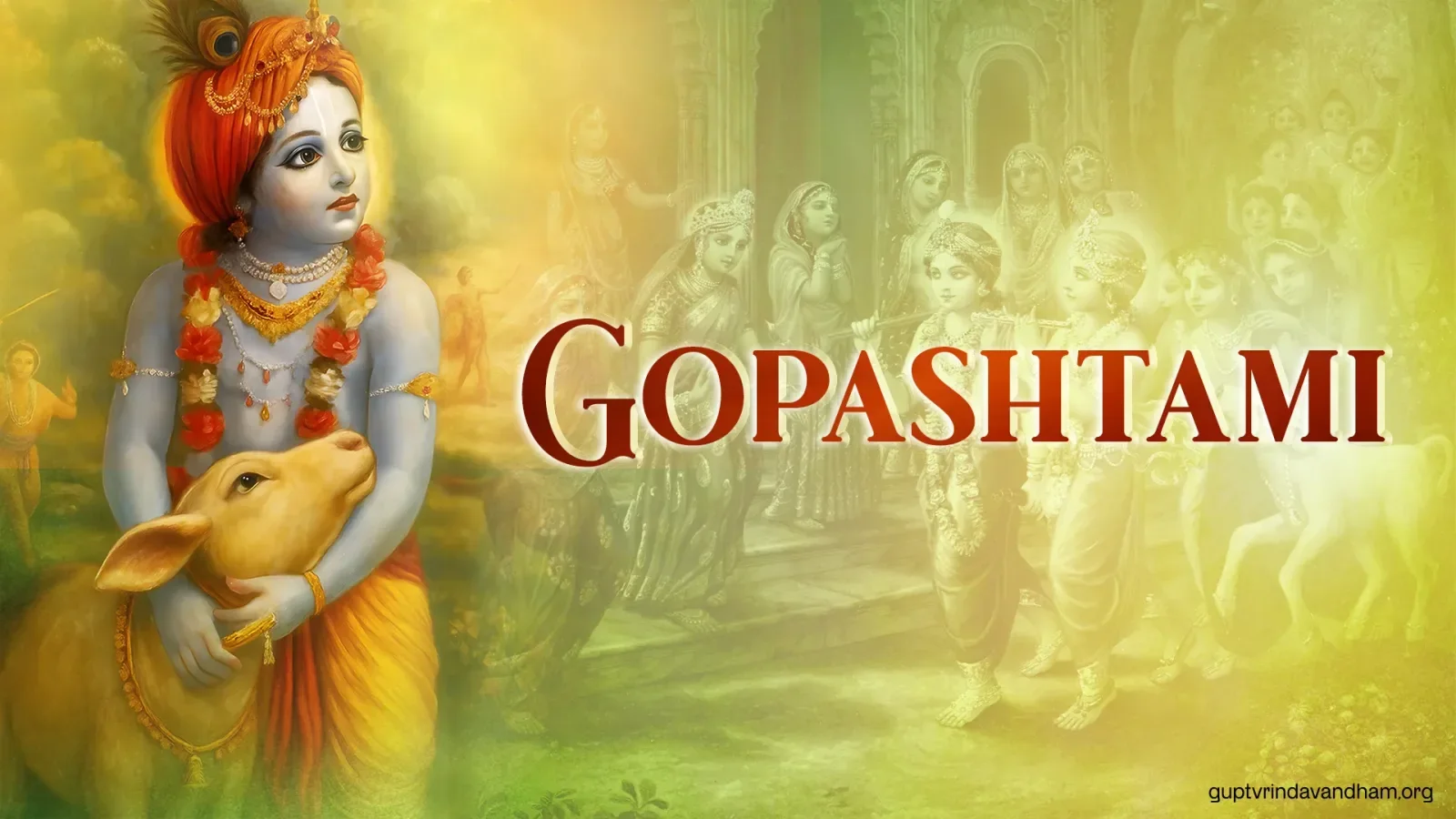
Observed on the eighth day of the bright fortnight of Kartik, Gopashtami celebrates the day when Krishna and His brother Balarama were first entrusted with tending the full-grown cows of Vrindavan. It is a festival of cows, of cowherds, and of the simple, natural culture that Krishna Himself chose to grow up in.
From Calves to Cows
The Srimad-Bhagavatam describes how, in their early childhood, Krishna and Balarama were given charge of the calves. They would take them to the pastures near their home and play with the other cowherd boys, imitating the calls of birds and animals (SB 10.11).
When the two brothers reached the pauganda age, roughly from six to ten years of age, the elders of Vrindavan allowed them to take charge of the cows themselves. The opening verse of SB 10.15 describes this moment: having grown into the pauganda age, Rama and Krishna were accepted as cowherds and began going to the forest with the cows and their friends. The tradition of Vrindavan remembers this as the occasion celebrated on Gopashtami.
A day in the forest
The Bhagavatam goes on to describe how Krishna led the cows into the forest of Vrindavan, playing His flute, while the bees hummed and the peacocks danced. He praised the beauty of the forest to Balarama, noticing how the trees bowed with fruits and flowers, how the deer and birds greeted Him, how the whole land of Vraja was blessed by His footsteps. In the evening, He returned home covered in the dust raised by the cows' hooves, and the gopis waited eagerly to see His face.
This picture of Krishna, with a stick in His hand, a flute at His belt, a peacock feather in His hair and cows all around Him, is the form that the residents of Vrindavan love most. It is the form of the Lord who chose to live not in a palace but in a village of cowherds.
Why the Lord Chose to Be a Cowherd
Krishna could have appeared in any situation. He chose a cowherd community, and that choice tells us something about the kind of life He values. In the Bhagavad-gita (Bg. 18.44), Krishna lists cow protection, along with agriculture and trade, as the natural duty of the vaishya community. He does not mention dairy as an industry; He mentions protection.
Srila Prabhupada spoke about this often. He explained that the cow gives milk like a mother, and so human society should regard her as one of its mothers. The bull, who ploughs the fields to produce grains, is like a father. A society that kills its mother and father for taste, he would point out, cannot expect peace. He established cow protection programmes and farm communities in ISKCON so that devotees could live this culture in practice, not merely discuss it.
The Lord's own prayer
A well-known prayer from the Vishnu Purana, often quoted by Srila Prabhupada, offers obeisances to the Lord as the well-wisher of cows and brahmanas, and as the benefactor of the whole world. In Vedic understanding, care for cows and respect for spiritual culture are the foundation for the welfare of all.
Gopashtami and the Month of Kartik
Gopashtami arrives during Kartik, close after Govardhan Puja, when the cows are also honoured in the festival of Go Puja. In 2026, ISKCON calendars list Govardhan Puja and Go Puja for 10 November. These two festivals belong together: at Govardhan, Krishna protected the cows and residents of Vrindavan from Indra's storms; at Gopashtami we remember Him taking up their daily care.
How to Observe Gopashtami
Honour the cows
Traditionally on this day, cows are bathed, decorated with flowers, colours and bells, offered worship, fed special foods and respectfully circumambulated. If you live near a goshala, visit and offer the cows fresh grass, jaggery or fruit (following the advice of the caretakers on what is suitable).
Remember Krishna as Gopala
Read SB 10.15 and the surrounding chapters about Krishna's cowherd pastimes, or Srila Prabhupada's Krishna book version. Sing songs about Gopala, or simply chant the Hare Krishna maha-mantra while meditating on Krishna leading the cows into the forest.
Choose a vegetarian, cruelty-free kitchen
Gopashtami is a natural day to reflect on what our food choices mean for animals. A devotee's kitchen offers only vegetarian food to the Lord, and many devotees try to source milk from protected cows wherever possible.
Support a cow for a day, a month or a year
Caring for cows, especially those that are old or no longer give milk, requires steady support for feed, shelter and medical care. Contributing to a goshala is a direct way to share in Krishna's own service.
The Spiritual Lesson of Gopashtami
Gopashtami reminds us that the spiritual life Krishna shows us is not abstract. It is lived in kindness to animals, in gratitude to the earth, in simple food offered with love, and in a community centred on God. The residents of Vrindavan did not think of cow protection as a cause; it was simply how they lived, because the cows were dear to Krishna and Krishna was dear to them.
In our busy cities, we may not be able to herd cows ourselves. But we can carry the spirit of Gopala into our homes: offering our food to Krishna, refusing to support cruelty, and helping those who give the cows a safe home.
Celebrate Gopashtami With ISKCON Visakhapatnam
Cow protection is part of the life of the Hare Krishna Vaikuntham Cultural Centre in Gambheeram. You can learn more about our cow care and sponsor feed and care through our Gau Seva page. To find out about this year's Kartik celebrations, visit our festivals page or check the Vaishnava calendar. And if you would like to serve in person, our volunteer team will be happy to hear from you.
May Gopala, the protector of the cows, protect all of us, and may we learn to love what He loves.