Bound by Love: The Damodar Pastime and the Prayer We Sing All Kartik
Why could no rope tie child Krishna until He agreed? The Damodar lila of SB 10.9, the meaning of the Damodarashtakam, and how to offer lamps in Kartik.
Updated 8 October 2026
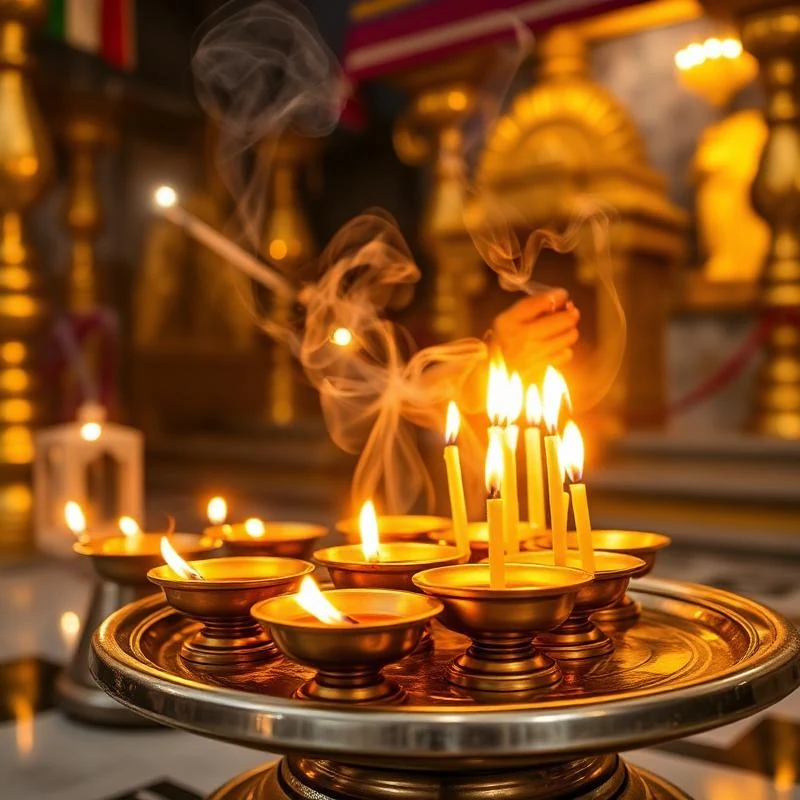
Each evening during the month of Kartik, temples and homes fill with the soft light of ghee lamps and the familiar melody of a Sanskrit prayer that begins namamishvaram sac-cid-ananda-rupam. This is the Damodarashtakam, the eight verses in glorification of Lord Damodar. For one month, devotees sing it daily while offering a lamp to the Lord.
But who is Damodar, and why does a short prayer about a child tied to a mortar hold such a central place in the Vaishnava year? To answer, we need to go to a single morning in Gokula, described in the ninth chapter of the Tenth Canto of the Srimad-Bhagavatam.
A Morning in Yashoda's Home
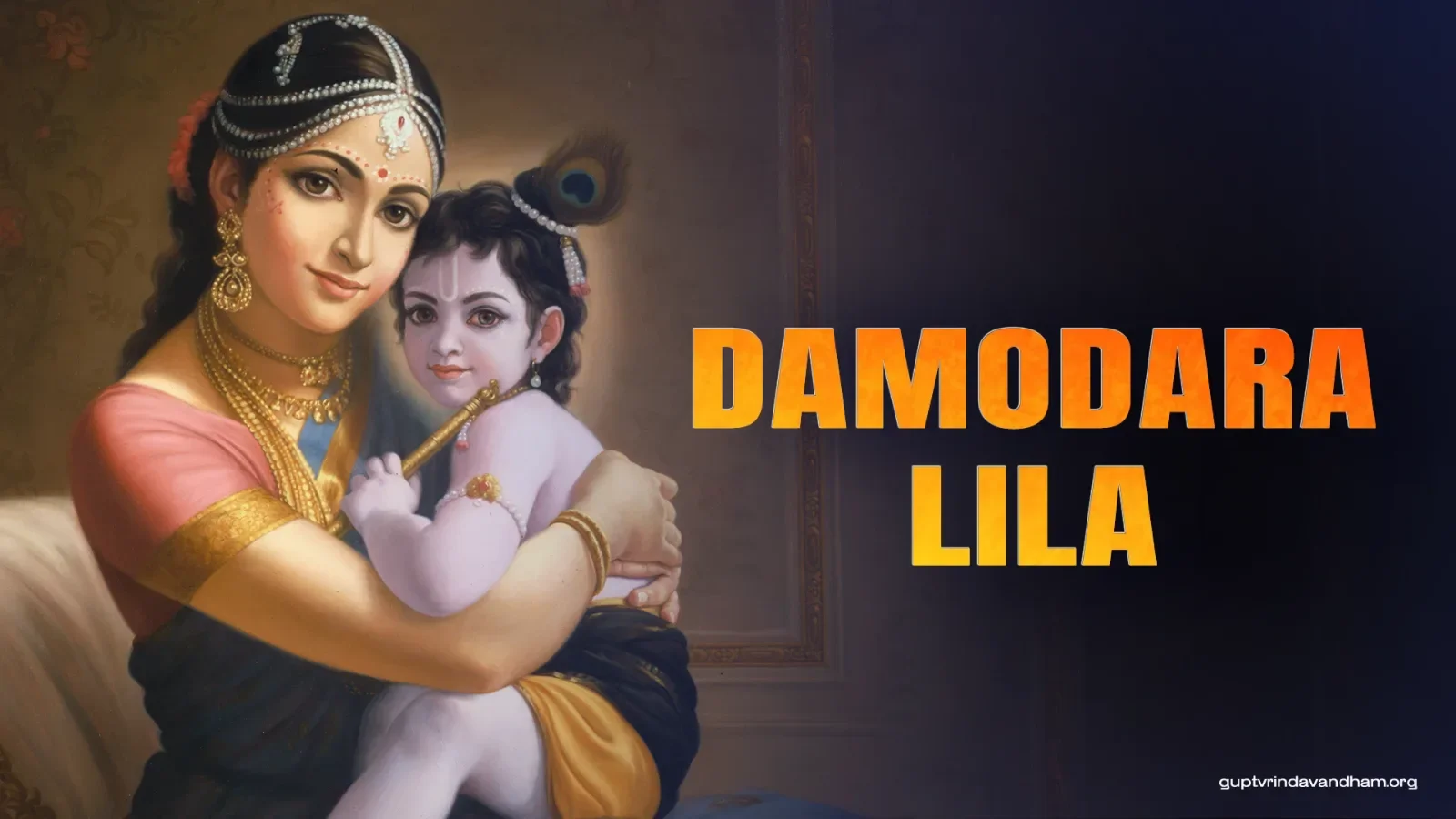
Mother Yashoda had sent her maidservants to other tasks so that she could churn butter herself for her son. As she churned, she sang about Krishna's childhood activities. The Bhagavatam lovingly describes her: the rope moving back and forth, her bangles jingling, flowers falling from her hair (SB 10.9.1–3).
Child Krishna came, hungry, and caught hold of the churning rod, wanting to drink her breast milk. She took Him on her lap and fed Him. But on the stove the milk began to boil over. Yashoda put Krishna down and hurried to save the milk.
The broken pot
Krishna was not pleased at being left unsatisfied. Biting His lips in anger, He broke the pot of yogurt with a stone, went into a corner, and began eating the fresh butter, sharing it with the monkeys. When Yashoda returned and saw the broken pot, she understood exactly what had happened. She picked up a stick and went to find her son.
Seeing her approach, Krishna jumped down and ran. The Bhagavatam remarks on the wonder of this scene: the Lord whom great yogis cannot reach even in meditation was being chased by His mother (SB 10.9.9). With difficulty, she caught Him. He was crying, rubbing His eyes with His hands, smearing the black ointment. Seeing her child frightened, Yashoda threw away the stick, but decided to tie Him up for a while so He would stay out of mischief.
The Rope That Was Always Too Short
Here comes the heart of the pastime. Yashoda brought a rope to tie Krishna to a wooden grinding mortar. But the rope fell short by the width of two fingers. She joined another rope to it, and it was still two fingers short. She brought every rope in the house, and every time, it remained two fingers short (SB 10.9.15–17).
The gopis of the neighbourhood began to laugh, and so did Yashoda, amazed. She kept trying until she was perspiring and exhausted, the flowers falling from her hair. Seeing His mother's tireless effort, Krishna became merciful and agreed to be bound (SB 10.9.18).
What the two fingers mean
Vaishnava acharyas have explained the meaning of the "two fingers" in this pastime. One common explanation is that they represent the two elements needed to "bind" the Lord: the sincere effort of the devotee and the mercy of the Lord. No amount of rope, no amount of personal strength alone, can capture Krishna. But when the devotee's sincere effort is complete, Krishna Himself supplies the mercy and allows Himself to be caught.
This is why the Lord received the name Damodar: dama means rope and udara means belly or waist. The Lord of the universe, with a rope around His waist, tied by the love of His mother.
Easy for Devotees, Hard for Everyone Else
Shukadeva Goswami then makes a striking statement. Neither Brahma, nor Lord Shiva, nor even the goddess of fortune received the mercy that Yashoda received (SB 10.9.20). And he adds (SB 10.9.21) that the Lord, the son of the gopi, is not easily attained by those who seek Him through severe austerities or philosophical speculation, but is easily attained by devotees.
This verse summarises the entire philosophy of bhakti. God is not a puzzle to be solved by intellect or a prize to be captured by force. He is a person who responds to love.
The twin Arjuna trees
The pastime continues in the next chapter (SB 10.10). While tied to the mortar, Krishna crawled between two tall arjuna trees and pulled them down. From the trees emerged two sons of Kuvera, Nalakuvara and Manigriva, who had been cursed by Narada Muni for their arrogance and were now liberated by Krishna's touch. They offered prayers and departed. Even while being "punished" by His mother, the Lord was delivering souls.
The Prayer of Satyavrata Muni
The Damodarashtakam was spoken by the sage Satyavrata Muni and is found in the Padma Purana. In its eight verses, the sage remembers the scene of Krishna running from Yashoda, His tearful eyes, His being bound, and the liberation of Kuvera's sons.
Most remarkable is the prayer's request. The sage tells the Lord that he does not ask for liberation or any other boon. He asks only that this form of the Lord, as the child of Gokula, should always remain in his heart. This is the Vaishnava ideal: to prefer loving service over even liberation. Srila Prabhupada recommended that devotees sing this prayer every day during Kartik, and that recommendation is followed in ISKCON temples worldwide.
How to Offer Lamps During Kartik
- Use a ghee lamp. A small clay or brass lamp with a cotton wick soaked in ghee is traditional.
- Offer before a picture of Damodar or Radha-Krishna. Move the lamp in gentle circles in front of the Lord.
- Sing the Damodarashtakam. If you do not yet know it, play a recording and follow along with a printed text.
- Include everyone. Let children, elders and guests take a turn. Kartik is a family festival.
- Remember the pastime. As you offer, think of Yashoda with the rope and Krishna allowing Himself to be bound.
Offer a Lamp to Damodar at Hare Krishna Vizag
Throughout Kartik, which ISKCON calendars show beginning on 26 October 2026, the Hare Krishna Vaikuntham Cultural Centre in Gambheeram invites everyone to come and offer a lamp to the Lord. Whether you have attended for years or are visiting for the first time, you are welcome. Please check the daily schedule for arati timings, see the festivals page for Kartik celebrations, and consider supporting the month's offerings through our donation page.
May the Lord who was bound by His mother's love also allow Himself to be bound in our hearts.