Nandotsava: The Morning After Krishna's Birth
The day after Janmashtami, Gokula erupted in celebration. Nanda Maharaja's festival teaches how love for Krishna naturally overflows into generosity.
Updated 8 October 2026
Janmashtami night is the high point of the Vaishnava year. Devotees fast, chant, hear the story of Lord Krishna's appearance in the prison of Kamsa, and at midnight welcome the Lord with abhishek and kirtan. But the Srimad-Bhagavatam does not end the story at midnight. The next morning, in the village of Gokula, an entirely different celebration bursts into life. This is Nandotsava, the festival of Nanda Maharaja, and it is one of the most joyful scenes in all of scripture.
Janmashtami has passed for this year, but Nandotsava offers a lesson that is worth carrying through every month: how a heart full of love for Krishna naturally overflows into generosity.
The Scene in Gokula
The Tenth Canto of the Srimad-Bhagavatam, chapter five, describes what happened when the news spread that a son had been born to Yashoda and Nanda. Nanda Maharaja, the chief of the cowherd community, was overwhelmed with happiness. He bathed, dressed himself properly, and called learned brahmanas to perform the birth ceremonies for the child. He had the prescribed rituals performed and the worship of the demigods and forefathers carried out according to custom.
Then he gave in charity on a scale that the Bhagavatam takes care to record. According to SB 10.5.3, Nanda gave two million decorated cows to the brahmanas, along with seven hills of sesame seeds covered with jewels, gold and fine cloth. For a cowherd king whose wealth was measured in cows, this was a gift of the whole heart.
A village beside itself with joy
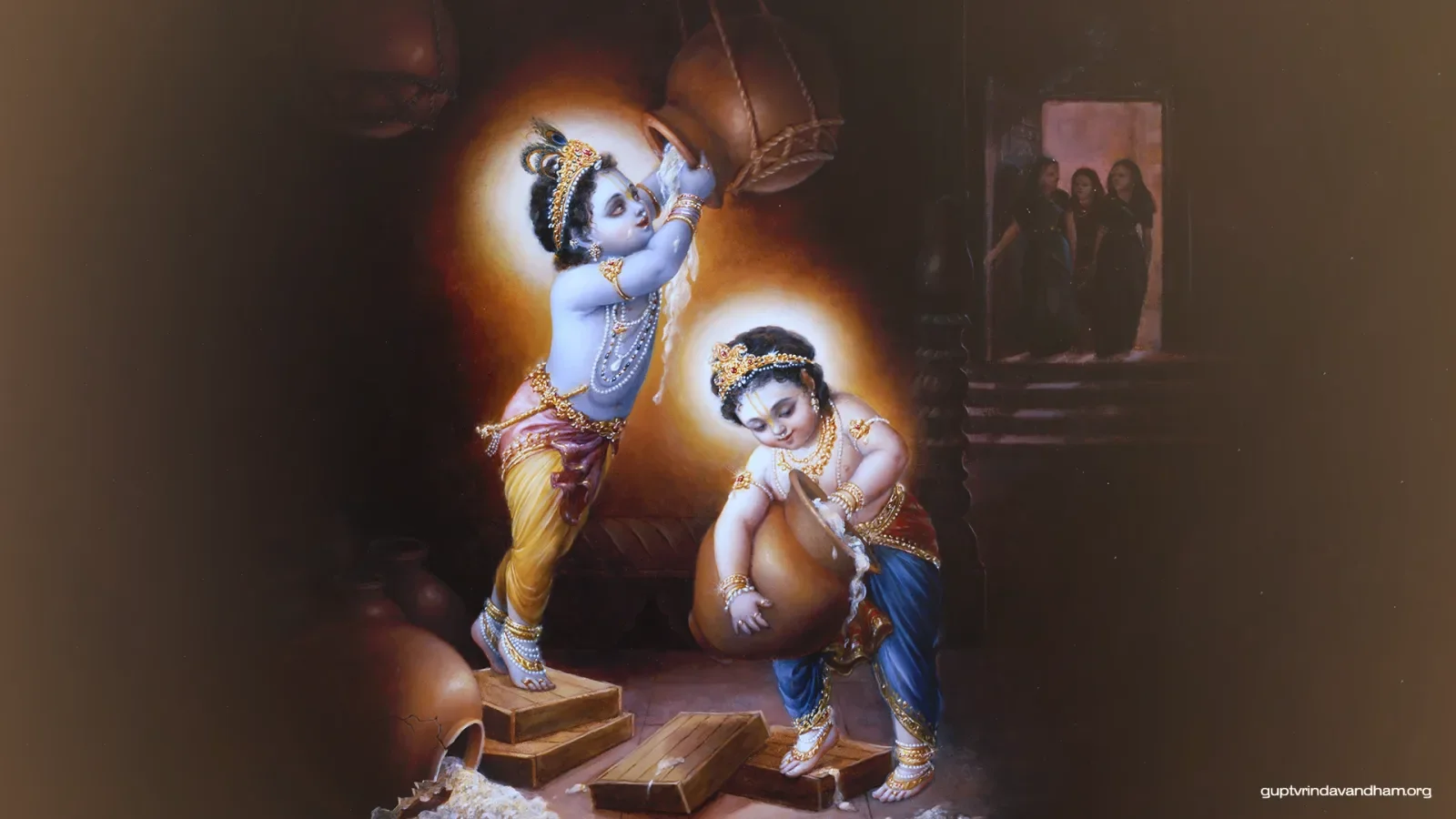
The Bhagavatam paints the whole of Vraja in festival colours. Houses were cleaned and decorated with flags, garlands and auspicious designs. The cows and bulls were smeared with turmeric and oil and adorned with gold and peacock feathers. The cowherd men arrived carrying gifts, and the gopis, dressed in their finest clothes and ornaments, hurried to Nanda's house with offerings for the newborn, their earrings swinging as they walked. In the excitement, the cowherd men began throwing butter, milk, ghee, yogurt and water upon one another, smearing each other with fresh butter. It is a picture of pure, unrestrained happiness.
Love Without Knowing He Is God
What makes Nandotsava so remarkable is that nobody in Gokula was celebrating the appearance of the Supreme Personality of Godhead. As far as they knew, their beloved Nanda had finally been blessed with a son, and that was reason enough to give away everything.
Srila Prabhupada often explained that this is the special glory of Vrindavan. The residents of Vraja love Krishna so intimately that they do not think of Him as God at all. Their love is not based on His power or on what He can give them. It is natural, spontaneous and selfless. In the Bhagavatam's own words, the Lord is not easily attained by those who rely on speculation or severe austerity, but He is easily attained by devotees who love Him in this way (SB 10.9.21).
This is why Gaudiya Vaishnavas do not view the residents of Vrindavan as minor characters in Krishna's story. They are the teachers of the highest form of love. Nandotsava shows us the quality of that love: it does not calculate.
Srila Prabhupada's Appearance on Nandotsava
For ISKCON devotees, Nandotsava carries an extra layer of meaning. His Divine Grace A.C. Bhaktivedanta Swami Srila Prabhupada, the founder-acharya of the International Society for Krishna Consciousness, appeared in Calcutta in 1896 on the day after Janmashtami, the very day of Nanda Maharaja's festival. For this reason devotees celebrate Nandotsava and Srila Prabhupada's Vyasa Puja together, offering homage to the spiritual master who carried the message of Krishna across the world.
It is a fitting coincidence. Just as Nanda Maharaja distributed his wealth freely to celebrate Krishna's arrival, Srila Prabhupada distributed the wealth of Krishna consciousness freely to every corner of the globe: the Holy Name, prasadam, and the knowledge of the Bhagavad-gita and Srimad-Bhagavatam.
Three Lessons to Carry Forward
1. Celebration and charity belong together
In Vedic culture, a happy occasion is never only for the family. Nanda's first impulse on hearing of his son's birth was to give. This is the root of the Indian tradition of feeding people and giving in charity on birthdays, weddings and festivals. When that charity is connected to Krishna, it becomes devotional service rather than mere social custom. The Lord explains in the Bhagavad-gita (Bg. 9.27) that whatever we give away should be done as an offering to Him.
2. Cows are wealth, and caring for them is worship
Nanda Maharaja was a cowherd, and the cows of Vraja appear throughout the story, bathed, decorated and honoured. Krishna Himself grows up among the cows and is known as Govinda, the one who gives pleasure to the cows. Caring for cows is not an old-fashioned sentiment; it is part of the culture Krishna personally established. When we support the protection of cows today, we are taking part in the same spirit that filled Gokula.
3. Joy is contagious when Krishna is at the centre
The butter-throwing scene in the Bhagavatam is not a description of disorder. It is a description of a community so united in love for one child that their happiness spills over in every direction. Our own temple festivals aim to recreate that atmosphere: kirtan, feasting, decoration, and everyone serving together.
How Devotees Can Keep the Nandotsava Spirit
- Mark family occasions with an offering. On birthdays and anniversaries, cook a special preparation, offer it to Krishna, and share the prasadam with relatives, neighbours or those in need.
- Give with a light heart. Nanda did not deliberate over how much to give. Even small, regular acts of charity offered to Krishna carry this mood.
- Remember the residents of Vrindavan. Read the Tenth Canto pastimes of Krishna's childhood, especially chapters five through nine, to enter into the mood of Gokula.
- Honour the spiritual master. Read a few pages of Srila Prabhupada's books each day as a way of thanking him for the gift of Krishna consciousness.
Continuing Nanda's Generosity in Vizag
At the Hare Krishna Vaikuntham Cultural Centre in Gambheeram, the spirit of Nandotsava continues throughout the year in practical ways. Through Anna Daan Seva and our Subhojanam programme, sanctified meals are served to those who need them. Through Gau Seva, devotees help care for cows, the dearest companions of Lord Krishna. And through Gita Daan, the wisdom that Srila Prabhupada brought to the world reaches new readers.
You do not need to wait for next Janmashtami to celebrate like Nanda Maharaja. Every act of service, every plate of prasadam shared, and every gift offered for Krishna's pleasure is a small Nandotsava in itself. To see upcoming celebrations, visit our festivals page.